
Sex Offender Checks in Cape May County
The New Jersey Sex Offender Internet Registry is the primary public source. New Jersey State Police manages the system under Megan's Law, while all 21 county prosecutors send records for state review and Internet publication. Local police and county prosecutors supply address information. A search can support awareness, but it is not a court jacket or a complete SBI criminal history.
Start with a carefully spelled name, then try a place-based route supported by the live portal. A no-result response is not proof that a person never registered. Tier 1 visibility, update delay, excluded records, changed names, and out-of-state registration can all affect public results. Similar names require comparison with the profile photograph and identifying fields.
Cape May Tier 1 Visibility
New Jersey's Tier 1 label means low assessed risk. Notification normally stays with law enforcement, so a reader should not assume that every Tier 1 registrant appears in an Internet search. Tier 2 supports notice to law enforcement and qualifying schools, day-care centers, camps, and registered community organizations. Tier 3 adds notice to members of the public likely to encounter the person.
This visibility rule explains why search silence needs restraint. It does not certify that no registration duty exists. The county prosecutor assigns a proposed tier under statutory factors and Attorney General Guidelines, defines the notification area, and the registrant may seek judicial review.
Cape May County notification is therefore tied to risk and likely contact, not one identical mailing rule for every registrant. A Cape May County Tier 2 record may reach institutions likely to encounter the person, while Tier 3 supports the broadest community notice. The Internet Registry displays qualifying records under state law, but it does not publish every low-risk registration.
How to Search the New Jersey Sex Offender Internet Registry
The state registry was behind an access challenge during the research inspection, so current button names, radius values, and live controls were not verified. They should not be invented. Use the official NJSP portal, accept its current warning and terms, and follow only the fields displayed during the live session. If access fails, the official national system provides a second route.
- Open the official NJSP Internet Registry and read the current terms and misuse warning.
- Use a well-spelled name or the geographic option the live form offers, without assuming unverified radius choices.
- Compare the result's photograph, aliases, age, physical details, offense, and location before deciding it is the intended person.
- Check the profile date and verify a suspected error through local law enforcement rather than confronting anyone.
Note: Public visibility depends on New Jersey notification law, so a blank search is not a clean-record certificate.
Cross-State Cape May Offender Search
The U.S. Department of Justice's Dru Sjodin National Sex Offender Public Website searches participating state, territorial, and tribal registries. It does not create a new criminal-history record. It is useful when a person may have lived outside New Jersey or when a Cape May address is only one point in a larger search.
| NSOPW field | Type | Required | Use note |
|---|---|---|---|
| First and last name | Text | Both for name route | County and city may narrow results |
| ZIP codes | Text | Alternative | Up to five, separated by spaces |
| State or territory | Select | Optional | Can broaden or narrow participating sources |
| Address and city | Text | Radius route | Used with state and a live distance choice |
| Indian Country | Select | Optional | Adds a tribal-jurisdiction search |
The official NSOPW service is shown in the assigned source image.
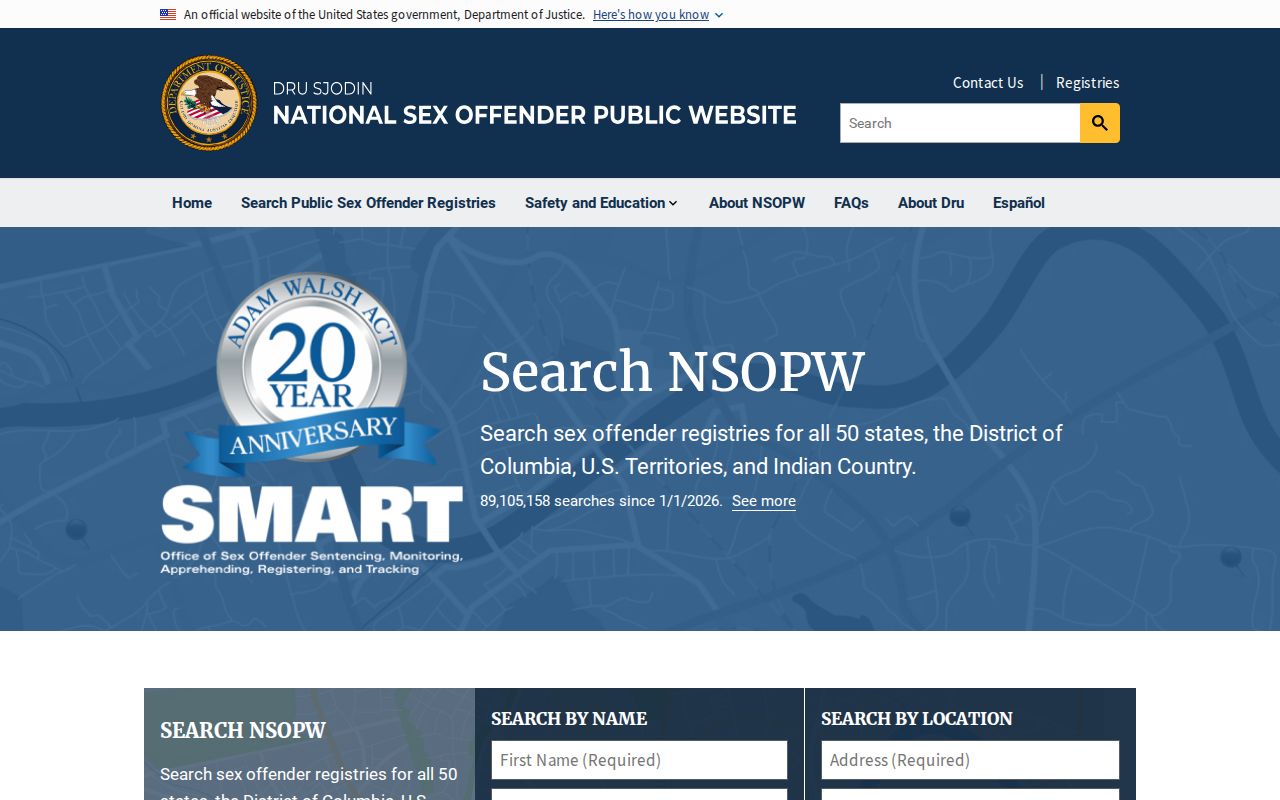
The national layer points back to participating jurisdictions and should be read with each source registry's limits.
Inside a Registry Profile
New Jersey law authorizes detailed public fields for qualifying moderate- and high-risk records. These help distinguish people and understand the basis for registration. They still describe a dated registry entry. Appearance, vehicle, and address data can change, while the court file remains the source for the full disposition.
| Identity | Name, aliases, age, date of birth, race, and sex |
|---|---|
| Appearance | Height, weight, hair, eyes, scars or tattoos, photograph, and photo date |
| Case | Qualifying offense, disposition date and place, brief description, and limited victim details |
| Risk | Moderate or high determination used for public notification |
| Location | Residence street, municipality, ZIP code, and county |
| Vehicle | Make, model, color, year, and plate when published |
Use more than a name. A registry hit should be matched across the photo and identifiers before it informs any safety choice.
Cape May Registry Address Flow
Registration begins locally. A person with a legal duty contacts the police department serving the residence. Areas without a municipal department should confirm the proper registering agency with the Cape May County Prosecutor. The prosecutor receives forms and performs tier assessment. NJSP then reviews submissions for completeness, accuracy, and Internet publication.
If a Cape May County registry address seems wrong, report it to law enforcement so NJSP can review and correct the state record. Suspected failure to register also belongs with the local police. Use 911 only for an emergency. The registry is an information source, not a substitute for a police tip or a reason for private investigation.
The Cape May County Prosecutor is part of that correction chain because county prosecutors assess tiers and transmit registry information. NJSP's state unit reviews those submissions and manages Internet publication. A reader should not try to repair a Cape May County profile through an unrelated court-search portal. Report the precise registry field and let the responsible agencies trace the source record.
New Jersey Registration Levels and Requirements
New Jersey tiers measure assessed risk of reoffense and notification reach. They are not the federal SORNA conviction tiers, and they do not create fixed 10-year or 25-year registration periods. Registration is presumptively for life, subject to the statutory Superior Court process and other controlling law. Verification schedules can depend on legal status and should be confirmed with the registering agency rather than guessed.
| New Jersey tier | Risk and notice | Internet effect | Duration |
|---|---|---|---|
| Tier 1 | Low risk; law enforcement notice | Ordinarily no general neighborhood notice | Presumptively lifetime, subject to court termination law |
| Tier 2 | Moderate risk; agencies and likely-contact organizations | Qualifying records are publicly searchable | Presumptively lifetime, subject to court termination law |
| Tier 3 | High risk; broadest likely-contact public notice | Broad Internet and community notice | Presumptively lifetime, subject to court termination law |
Tier affects notice, not whether the underlying conviction can be ignored.
The Cape May County sex offender search is also separate from the court case file. A public profile gives limited offense and disposition facts, while the court file can contain the formal judgment and other releasable case material. Use the registry for current lawful notice and the court for the prosecution record.
Cape May Fifteen-Year Standard
N.J.S.A. 2C:7-2(f) provides a possible Superior Court route to termination. An applicant must prove no offense during the 15 years after conviction or release from a correctional facility, whichever is later, and must show that the person is not likely to threaten others' safety. Fifteen years is an application standard, not automatic removal.
Eligibility can turn on the offense, sentence, later conduct, and current case law. A registrant seeking relief should use the court process and legal help rather than assume a date ends the duty. The New Jersey Office of the Public Defender's Special Litigation Unit handles tier hearings and some termination litigation.
The statutory clock runs from conviction or release from a correctional facility, whichever comes later. It also requires a court finding about safety. Those two points make a simple anniversary calculation unreliable. Public registry data may remain online while a petition is pending, and only a court order plus completed agency action changes the legal duty or public status.
Cape May Residency Claims Need Proof
The cited New Jersey Megan's Law materials do not establish a verified statewide rule that every registrant must live a set distance from every school. Parole conditions, a specific judgment, and a local enactment are separate legal issues. A Cape May County sex offender search should not turn those different rules into one blanket statement.
Check current statutes and controlling decisions before relying on a distance claim. The registry address is published for lawful notice. It does not grant permission to visit the location, track a household, publish accusations, or interfere with anyone.
The NSOPW mobile app offers a separate proximity tool. Its documented distances are one-quarter mile, one-half mile, and one mile, with offender-name searching as well. When a participating jurisdiction does not provide coordinates, the app substitutes a ZIP search. That fallback is a technical limit, not evidence that no qualifying profile exists near a Cape May County address.
Community Notification and Lawful Use
Registry information supports personal and family safety and community awareness. Read it in context, allow for update delays, and take genuine concerns to police. Do not treat the registry as proof of a new crime. Do not confront a listed person or anyone at the address.
Registry misuse is a crime: N.J.S.A. 2C:7-14 requires a warning against threats, intimidation, harassment, or other misuse. Under N.J.S.A. 2C:7-16(b), using registry data to commit another offense adds criminal penalties.
New Jersey may temporarily remove personal information when actual or threatened misuse creates danger, then restore it when practical. Responsible use means verifying the official record and contacting law enforcement with a valid safety concern.
Community notification also differs by risk. Law enforcement receives Tier 1 notice. Schools, licensed day care, camps, and registered community groups likely to meet a Tier 2 person can receive broader notice. Tier 3 reaches members of the public likely to encounter the registrant. That structure is more precise than treating every Cape May County profile as subject to the same public distribution.
A registry profile may also list the qualifying offense, disposition location, limited victim age and gender information, a short account of the conduct, scars or tattoos, and vehicle data. Those fields help verify identity, but none authorizes a reader to seek out a person. When a detail looks stale, preserve the official profile information and report the suspected error through police channels.